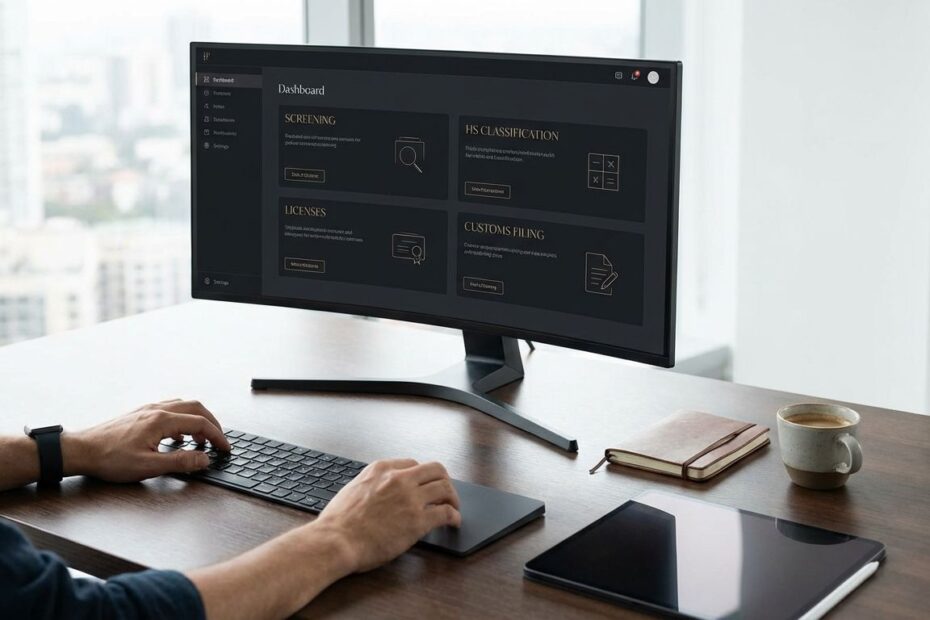
International trade management platforms help you control import and export compliance, customs processes, classification, and screening in one operational system that supports daily execution. The best options give you reliable content updates, audit-ready workflows, and integrations that keep orders moving without creating compliance gaps.
If trade touches revenue, your platform choice stops being an IT decision and becomes an operating model decision. This guide breaks down ten widely used platforms and specialist tools, how each one earns its place, and how to choose based on the work your team must execute every day, screening, HS/HTS classification, license controls, customs filing, recordkeeping, and exception handling.
After reading, you should be able to shortlist two or three realistic candidates, write tighter requirements for demos, and run a pilot that exposes the real blockers: data quality, integration depth, match logic, filing coverage, and support responsiveness.
1. SAP Global Trade Services (SAP GTS)
If operations already run through SAP, SAP GTS is often the most direct route to embedded trade compliance controls inside core order-to-cash and procure-to-pay flows. It is built to run real-time checks so compliance decisions happen where transactions happen, not in a side spreadsheet that someone updates after the shipment left the building. That design matters when the cost of a wrong release is a border hold, a rework cycle, or a customer escalation that lands on an executive desk.
SAP positions GTS around three operational pillars: Sanctioned party list screening, customs management, and import and export management. Screening can block a transaction for review when a check fails, and workflows support processing of blocked documents. Customs management focuses on accurate product categorization for trade documentation and tariff code determination. Import and export management connects to logistics processes and multiple government customs systems, with embargo checks, license management, and inline blocking and release.
Where SAP GTS earns its reputation is governance. You can design controls that remain stable when volume spikes, new business units onboard, or audit scrutiny increases. The trade-off is that implementation quality depends on your ability to define master data standards, integration touchpoints, and ownership across logistics, customer master, vendor master, and finance.
2. e2open Global Trade Management
e2open is a common shortlist entry when you need a broad GTM suite that can support classification, export controls, and screening with strong automation. It targets teams that must keep transactions flowing across many countries, many product lines, and many partner types, without placing manual review in the critical path for every shipment. If your current process depends on “tribal knowledge,” e2open’s value shows up quickly when you standardize decisions and eliminate repetitive checks.
On the export compliance side, e2open highlights product classification aligned to the latest HS codes and export control numbers, access to over 900 restricted party and sanctions lists, automated compliance checks across many country-specific regulations, and guidance on restrictions and license requirements. It also supports centralized document management so licenses, exemptions, end-user statements, and other critical documents remain tied to transactions and easy to retrieve during internal reviews and external audits.
In practice, this platform fits best when you need scale and you accept that the hardest part is not “having features,” it is tuning match logic, aligning policy decisions, and keeping content governance tight. The vendor story may be strong, yet your success still hinges on how your team handles false positives, exception queues, and integration mapping to ERP and order management systems.
3. Descartes Customs And Regulatory Compliance (Descartes)
Descartes is a serious contender when the operational requirement is “one connected compliance operation,” not a loose bundle of tools. It is positioned around customs and regulatory compliance execution at scale, with a footprint that supports high transaction volumes and measurable compliance operations control. That is useful when leadership demands predictable throughput and a clear audit trail, not just compliance “coverage” claims.
On Descartes’ customs and regulatory compliance positioning, the company cites large operational metrics: 100M compliance filings per year and 700M restricted party screenings per year, paired with “360° control of compliance operations.” Those numbers matter less as marketing and more as a signal that the platform is built for enterprise throughput, queue management, and repeatable execution.
Descartes tends to fit organizations that run active in-house compliance operations and want tighter controls around filings, screening, and process visibility. It also works well when a trade team must coordinate across forwarders, brokers, internal plants, and shared service teams, and needs consistent execution rather than local workarounds.
4. Descartes Visual Compliance (Integrated Denied Party Screening)
If your biggest pain is screening that lives outside the transaction flow, Descartes Visual Compliance is designed to fix that. It focuses on integrated denied party screening so checks happen automatically inside the systems your teams actually use, ERP, CRM, ecommerce, and internal applications. That reduces manual error and eliminates the “someone forgot to screen” risk that shows up during audit sampling.
Descartes Visual Compliance explicitly promotes integration with business systems including SAP, Oracle, Salesforce, Microsoft Dynamics, NetSuite, Infor, Shopify, plus custom and legacy systems. The platform pitches configurable screening algorithms, real-time screening at multiple points, and automation designed to improve consistency across departments that touch trade risk: export compliance, supply chain, finance, sales, procurement, and more.
This product often lands well in organizations that already have a trade process but need enforcement inside daily workflows. The operational win comes from designing trigger points that match your risk model, lead creation, customer onboarding, order entry, shipment creation, invoice release, and rescreening cycles when lists update.
5. Thomson Reuters ONESOURCE Denied Party Screening
ONESOURCE Denied Party Screening is a strong option when leadership wants a dedicated screening capability with a clear content story and configurable risk controls. If your trade compliance program needs consistent due diligence across customers, suppliers, and partners, screening must be reliable, defendable, and repeatable. That means content quality, list management, and the ability to show how decisions were made.
Thomson Reuters positions ONESOURCE DPS around automatically screening against 750+ global denied party lists. It also highlights integration with import and export management, including the ability to automatically block transactions when screening hits occur, which is operationally important when teams must stop orders without relying on manual follow-up. It also emphasizes content validation processes that correspond with government agencies to address issues in regulatory information, a claim that can matter when compliance leadership evaluates defensibility.
This platform usually fits teams that treat screening as a core control and want a vendor with deep content and data operations. The practical selection criteria are simple: match accuracy, false positive management, audit reporting, integration options, and how quickly the tool can rescreen large populations when lists change.
6. MIC Customs And Trade Compliance Cloud (MIC-CUST)
MIC is built for companies that need serious customs execution across many countries, with a preference for one consistent system rather than a patchwork of local tools. If your customs program runs self-filing in multiple regions, the operational burden is not just filing itself; it is keeping data mapping consistent, controlling broker handoffs, managing special regimes, and maintaining stable performance during regulatory change cycles.
MIC states that more than 1000 customers in 55+ countries use its customs and trade compliance software. On the customs filing side, MIC-CUST is positioned as a centralized (self) filing solution across more than 55 countries, including direct data exchange with national customs authorities and support for special customs regimes and inventory management. MIC also highlights AI-assisted capabilities aimed at improving customs tariff and export control classification and automating trade document processing.
MIC is a strong fit when customs complexity is your primary driver, high SKU counts, intercompany flows, multi-country declarations, and heavy reliance on standardized filing logic. It is also a strong fit when internal stakeholders demand a single operating model for customs rather than local variations that create training and audit headaches.
7. Livingston TradeSphere
TradeSphere is positioned as a practical solution focused on automating trade compliance steps and reducing manual error. It has been marketed with a straightforward message: keep up with frequent regulatory changes and maintain an audit trail without turning your trade team into full-time data janitors. If the current operation relies on repetitive manual checks, automation and daily updates can tighten control quickly.
Livingston’s press release introducing TradeSphere describes it as software designed to automate trade compliance and reduce human error, supporting import and export activity with fewer delays and incidents. It also states the software automatically updates daily to keep current on compliance regulations and supports a comprehensive audit trail, both of which align with common compliance program requirements: show what was checked, when it was checked, and what decision followed.
This platform tends to work best when you want a packaged compliance workflow that can be adopted without rebuilding your entire architecture. It still needs disciplined data inputs and clear ownership for exceptions. No platform eliminates accountability; the better platforms make accountability visible and measurable.
8. Descartes CustomsInfo (Global Trade Content, HS/HTS, And Rulings)
If classification and tariff research drive the majority of your compliance workload, you need a trade content engine that is current, searchable, and defensible. Descartes CustomsInfo is positioned exactly for that: import classification, tariff duty determination, landed cost calculations, and trade research tooling that supports collaboration and recordkeeping. When duty rates swing or policy interpretations shift, content quality becomes operational risk control, not a “nice to have.”
Descartes CustomsInfo markets trade research across 190+ countries, with advanced HTS code search and tariff code lookup, regulations updates, landed cost tools, and collaboration. It also claims access to trade data from over 6 million regulatory sources and highlights integration into ERP systems like Oracle and SAP. That integration note matters because classification research cannot remain isolated; it must feed item master decisions and entry data consistently.
This tool fits best when the organization needs defendable classification decisions and fast research workflows that scale across teams. It also supports a more mature governance approach where classification decisions are documented, reviewed, and reused, rather than re-litigated for every shipment and every new hire.
9. Building A Split-Stack With A GTM Suite Plus Best-Of-Breed Modules
A full-suite GTM can cover a lot, yet many mature trade organizations still choose a split-stack model: one system runs transactional controls, while specialist tools handle trade content or screening. That choice is not indecision; it is a recognition that screening accuracy, content freshness, and classification research have their own operational demands. A suite may do “enough,” yet the business may require “best possible” for a specific control.
This is where combinations become practical. SAP GTS can own transaction blocking and ERP-aligned governance. A dedicated screening tool can deliver configurable match logic and rescreening at scale. A trade content platform can serve as the source for classification research, rulings support, and collaboration. The goal is clean ownership: one system decides, another system supplies evidence, and integrations keep data aligned.
If a split-stack is under evaluation, the non-negotiables are integration latency, master data governance, and audit reporting that remains coherent across systems. Compliance leaders should not accept a setup where a regulator asks “why was this released?” and the answer requires three systems, two spreadsheets, and one person who is on vacation.
10. How To Choose The Right Platform Without Getting Trapped In Demos
Vendor demos tend to look similar: screening dashboards, classification lookups, workflow queues, and reports. Selection becomes easier when the evaluation is anchored to your real operating rhythm: how orders enter the system, where decisions must occur, who approves exceptions, and how changes are pushed across regions. A platform that cannot support your exception throughput is not a platform; it is an expensive bottleneck.
Start with the controls that protect cash flow. Screening must run at the right points and block correctly. Classification must be reusable and defensible. License logic must be transparent. Customs filing must match your countries, regimes, and broker model. Then test integration, not with a diagram, with a working pilot that moves real transaction shapes through your environment.
Procurement should also pressure-test operational support. Ask for support SLAs and escalation paths, content update cadence, and how the vendor handles regulatory changes that require immediate rule updates. If support responsiveness is weak, the platform becomes a risk amplifier during peak shipping seasons and policy change cycles.
Best International Trade Management Platforms
- SAP GTS for SAP-centric trade controls
- e2open for export controls, classification, and screening automation
- Descartes for high-volume customs and compliance operations
- MIC-CUST for multi-country customs self-filing
- CustomsInfo, Visual Compliance, ONESOURCE for specialist content and screening
Make The Shortlist, Then Run A Pilot That Forces Real Answers
A “best platform” claim only matters when it survives your transaction reality: order volumes, product complexity, countries shipped, and audit expectations. Build a shortlist that mixes a true GTM suite with the specialist modules your controls depend on most, screening, classification content, and customs filing coverage. Then run a pilot that measures false positives, queue throughput, integration latency, and decision traceability from master data through release. When the pilot is done, the winning platform will be obvious because it will keep shipments moving and still give compliance leadership clean evidence for every decision.
References
- SAP Global Trade Services (SAP GTS)
- e2open Export Management And Compliance
- Descartes Customs And Regulatory Compliance
- Descartes Visual Compliance Integrated Screening
- Thomson Reuters ONESOURCE Denied Party Screening
- MIC-CUST Customs Compliance Software
- Livingston TradeSphere Press Release
- Descartes CustomsInfo Global Trade Content

Thomas J Powell is Senior Advisor at The Brehon Group with over 35 years of experience in private equity, commercial banking, and asset protection. An international lecturer and policy expert, he specializes in financial structuring, asset strategies, and addressing middle-income workforce housing shortages.